
Charge it right.It’ll outlive the car.
Charging windows, first-install steps, safety and troubleshooting for every Advanced Electric pack — including the models we no longer build.
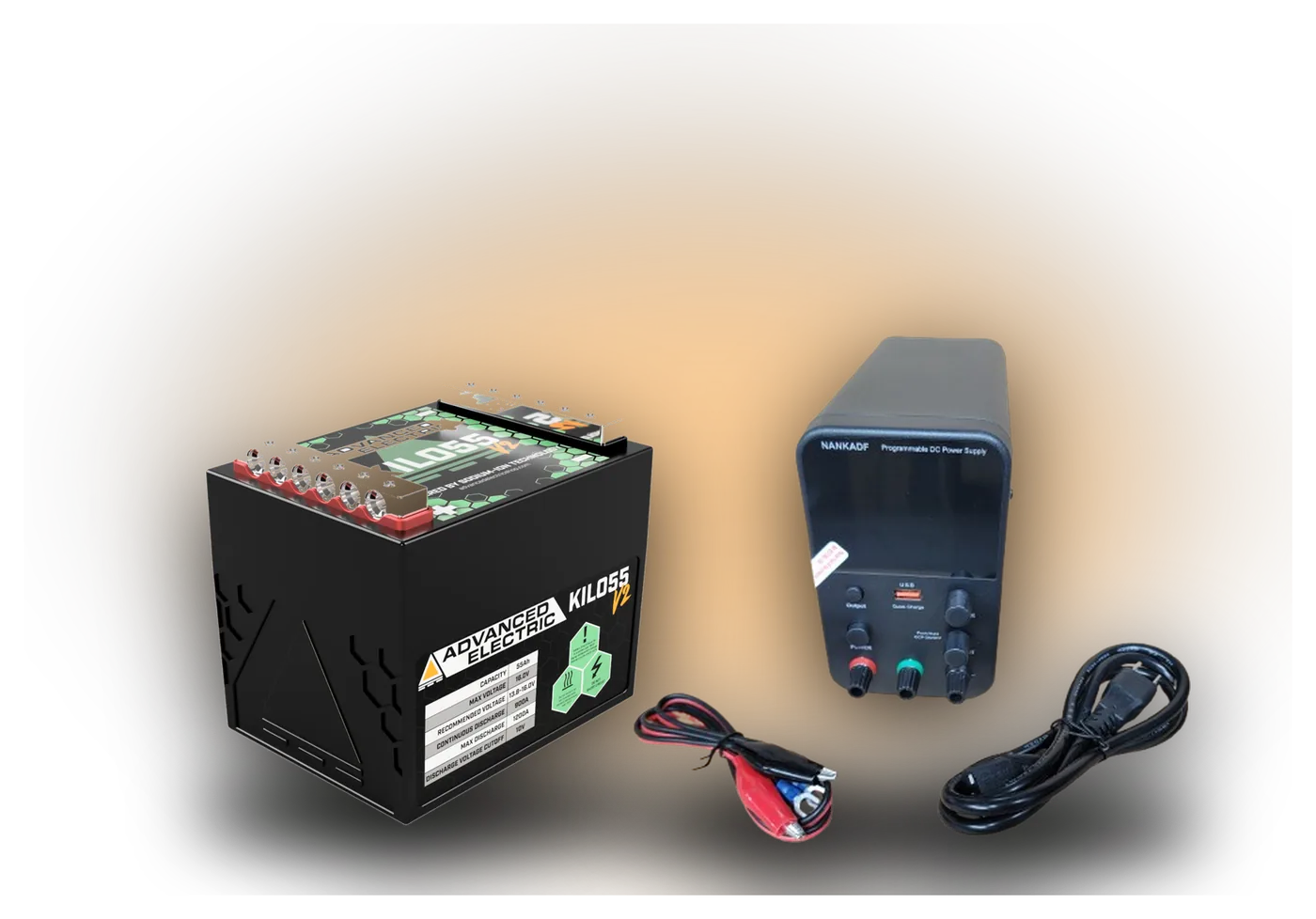
Your pack ships at 30% charge.
Every battery leaves here at roughly 30% state of charge — that’s deliberate, for safe transport, not an oversight. A sodium ion pack will read around 11V out of the box.
Before it goes in the vehicle
Bench-charge it up to your vehicle’s charging voltage first. 10A is plenty — there’s no rush. Dropping a 30% pack straight onto a running alternator is the fastest way to have a bad first day with it.
Charging
Know your window.
Every chemistry has a floor and a ceiling. Above the ceiling you damage the pack and void the warranty. Below the floor you simply never see the output you paid for.
| Pack | Charging window | Max | Set it to | Max alt charging |
|---|---|---|---|---|
| KILO HP40 / HP80 | 13.8 – 15.5V | 15.5V | 15.5V | 375 / 750 A |
| KILO HP 200 | 13.8 – 16.0V | 16.0V | 14.4 – 16.0V | 1,200 A |
| Legacy KILO 37 / 55 / 110 | 13.8 – 15.5V | 15.5V | 15.5V | 250 – 700 A |
| AE15 / AE30 / AE45 LTO | 15.2 – 16.2V | 16.2V | 16.0V | — |
| THE DON 55 / 110 / 220 NMC | 14.8 – 16.6V | 16.6V | 15.3V nominal | 200A+ alternator |
| AE LV 20 / 40 / 80 / 160 LiFePO4 | 12.8 – 14.6V | 14.6V | 14.4V (stock alternator) | Stock alternator |
Never undercharge LTO
We do not recommend charging LTO below 15.2V. Premature failure caused by undercharging is not covered under warranty — this is the single most common way people kill an otherwise 40,000-cycle pack.
Never exceed the max
15.5V on the KILO line (16V on the HP 200), 16.2V on LTO, 14.6V on AE LV, 16.6V on THE DON. If your alternator or external regulator can overshoot, set it and verify it with a meter before connecting the pack.
Mixing chemistries: sodium only
Lithium chemistries (LTO, LiFePO4, NMC) are never banked together — that is unsafe. Sodium ion is the only chemistry we bank alongside a lithium pack, and only inside the narrow band both windows share (LTO: 15.2 – 15.5V, 16V with an HP 200). Set the charging system at the top of that band; every product page shows the overlap for that pack.
Troubleshooting
Find it before you buy anything.
Voltage does not drop because a battery is vaguely weak. It drops because current is flowing through resistance — and a 0.01 ohm connection at 800A costs you 8 volts. So the question is never “is my battery good”, it is where is my voltage going. Work these five in order. Most people find it well before step five.
1 — Measure at the amplifier, not the battery
Meter on the amp’s power and ground terminals while the system is playing hard. If the battery holds 13.5V and the amp only sees 11V, the battery is fine — two volts are disappearing in the wiring between them and no new pack will fix that. If both read the same low number, carry on down the list.
2 — Check the grounds, then check them again
Meter between the amplifier’s ground terminal and the battery negative post while it plays. Under 0.1V is fine. Over 0.3V is your problem. Look for paint under the ring terminal, a factory seam doing the job of solid chassis, or a ground point that has survived three builds.
3 — Torque every terminal
Finger-tight measures fine cold and falls apart under load. Battery posts, distribution blocks, amplifier terminals, alternator output. While you are there, look for discoloured lugs or brittle insulation — that connection has been getting hot, and heat means resistance.
4 — Check charging voltage against your chemistry
A pack charged below its window is not sagging, it is undercharged — and sustained undercharging damages it permanently. Every chemistry has its own floor and ceiling: sodium ion 13.8 – 15.5V (HP 200 to 16V), LTO 15.2 – 16.2V, NMC (THE DON) 14.8 – 16.6V, LiFePO4 (AE LV) 12.8 – 14.6V. Meter the charging voltage at the pack and check it against the table above — that table is the authority.
5 — Only now, suspect the bank
If the wiring is solid, the grounds measure clean, the terminals are tight and the charging voltage is right, then capacity is worth looking at — and the number that matters is discharge rate, not amp-hours. The Battery Advisor sizes it both ways and tells you which limit you hit first.
What normal sag looks like
A volt or so of drop on a hard note that snaps straight back is healthy. Two volts with a slow recovery means you are at the edge of what the bank can do. Three or more, or amps dropping into protect, is a fault worth chasing.
Cells reading uneven
The pack is actively balanced, so give it a full charge cycle at the recommended voltage and re-check. If a cell stays out of line after a full cycle, send us the readings.
The long version, with the reasoning behind each check, is in why your voltage drops on the hit.
Safety, plainly
What we’d want you to know.
These are high-current energy storage devices. Treated properly they’re extremely safe — sodium ion especially. But we’d rather tell you the real risks than pretend there aren’t any.
Sodium ion is the safer chemistry
It’s far more tolerant of abuse than lithium and much less prone to running away thermally. It also contains no metallic sodium — despite what you’ll hear repeated online, these are not water-reactive.
Short circuits are the real danger
Not fire, in normal use — a dropped wrench across the terminals. At 1,200A of available current a short will vaporise metal instantly. Cover terminals during install and pull your rings off first.
If a pack ever vents
Get people away from it and ventilate the space — vented gas is both toxic and flammable. Don’t breathe it, don’t lean over it. Then call the fire service and tell them it’s a battery.
On fire: call 911 first
Per the DOT Emergency Response Guidebook (Guide 147, which covers both lithium ion and sodium ion), the correct response to a small battery fire is large amounts of water — not dry chemical, not CO₂. For anything larger, let it burn out and protect the surroundings. Get out and let professionals work.
Never charge outside the window
Overcharging is the most common way a pack is damaged. Set your voltage, verify it with a meter, and don’t rely on a regulator you haven’t checked.
Physical damage means retire it
A dropped, crushed or punctured pack should come out of service even if it still reads fine. Internal damage doesn’t always show up on a meter. Contact us before you scrap it.
A note on the water myth
You’ll see it claimed that you must never put water on a sodium battery. That’s true of sodium-metal and sodium-sulfur cells, which react violently with water. It is not true of sodium-ion, which contains no metallic sodium. Our Safety Data Sheet is the authority here — ask us for a copy and we’ll send it.
Questions
The things people actually ask.
Choosing a pack, charging, ordering, lead times, returns and safety. If yours is not here, email us — a person reads it.
Choosing a battery
Which chemistry do I want?
How many do I need?
What wattage rating should I trust?
Can I run different sodium models together?
This is one of the real advantages of staying on one chemistry: you can start with what you can afford and add capacity later without replacing what you already own. The legacy KILO37 V2, KILO55 V2 and KILO110 V2 pair with the HP line too.
Wire them with matched cable lengths so they share current evenly, and make sure every pack in the bank is at a similar state of charge before you connect them together.
Can I mix chemistries on the same bank?
Can I mix LTO, LiFePO4 or NMC with each other?
Can I run these with my existing AGM battery?
Charging
What voltage should I charge at?
My cells are reading uneven.
Why can’t I charge LTO below 15.2V?
My new battery arrived reading 11 volts. Is it faulty?
Do I need a special charger?
How big an alternator do I need?
Ordering & lead times
Why is sodium a pre-order?
Is LTO in stock?
Where am I in the queue?
Can I cancel a pre-order?
Can I return it if I change my mind?
Do you take payment up front?
Shipping
Can I pick up locally?
Can you ship outside the US?
Safety
Are these safe to have in a car?
Trade
Do you do dealer pricing?
Do you have an affiliate program?
What happened to the KILO37, 55 and 110?
Discontinued models
We don’t delete your pack.
The KILO37 V2, KILO55 V2 and KILO110 V2 were discontinued in April 2026. Their product pages, specs and charging rules stay online permanently. If you own one, nothing here goes away — and the sodium ion charging rules above still apply to it.